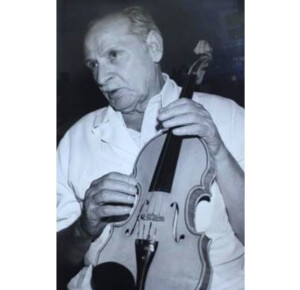
Guido Pascoli
*1905 , Itobi †1986 , São Paulo
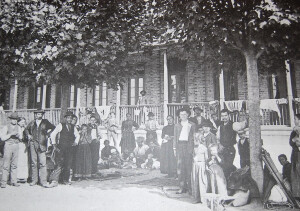
European immigrants pose for a photograph in the central courtyard of the Hospedaria de Imigrantes de São Paulo, ca. 1890
Son of Immigrants
Guido’s parents arrived in Brazil around 1895 and were taken in by the Hospedaria de Imigrantes in São Paulo, which had been providing temporary shelter to immigrants since 1887. Pietro Pascoli became a bricklayer in São Paulo, met his wife, and together they moved to the village of Itobi. There, their five children were born: Benvenuto (1902), Americo, Guido (1905), Valdomiro, and Rosa. The Pascoli brothers spent part of their childhood in Itobi. The family moved to Poços de Caldas, where they first came into contact with violin making through the cellist and clarinetist Guido Rocchi.
Guido Rocchi played a major role in the lives of Guido and his brother. He was a key figure in the Brazilian music scene. Rocchi had come to Brazil with an Italian opera company and stayed there. In São Paulo, he taught at the conservatory and had taught himself how to build string instruments.
In 1915, Guido’s older brother Benvenuto began repairing instruments for him. Guido followed in his brother’s footsteps, and both took lessons from Rocchi; Benvenuto played the clarinet, and Guido took violin lessons. Both brothers repaired instruments for the major casino and theater orchestras in Poços de Caldas. Given the number of Italian musicians who had migrated to the region, these instruments were likely predominantly of Italian or French origin.
Furniture maker and violin maker in São Paulo
Under Rocchi’s guidance, Guido and his brother honed their skills. In an interview, Guido cites 1922 as the first year he built a violin on his own. Benvenuto moved to São Paulo sometime in the early 1920s. Once again, Guido, who was 17 at the time, followed him shortly thereafter. During the day he worked as a furniture maker and in the evenings as a violin maker. In 1922, the brothers opened their own shop, the “Casa di Musica e Liuteria Cremona.” In 1927, Benvenuto became the owner of another musical instrument shop. Salvatore Vitale was also registered at the same address. The brothers presumably worked for this maker at first and later took over the business from him.
São Paulo had a vibrant music scene with many theaters, movie theaters, and concert halls. The São José Theater hosted performances by traveling musical troupes visiting the city. But even before that, São Paulo was already on the tour itinerary of major Italian troupes. The theaters offered a vast number of performances. The audience attending these performances was a new cosmopolitan class consisting largely of Italians.
Demand for musical instruments was therefore high. In São Paulo, both the trade in and the production of stringed instruments were primarily the work of Italian immigrants. Their small businesses provided employment for other Italian immigrants. Fritelli, an Italian contemporary, was resourceful and successful, and as a result he quickly became a role model for younger violin makers such as the Pascoli brothers.
Rio de Janeiro and his first business
After a year, Benvenuto moved to Rio de Janeiro. In the 1920s and ’30s, that city was considered a hub of musical vitality. Benvenuto began a partnership with Amos Bartolini, an Italian musician who taught at Rio’s opera house (Theatro Municipal). Together, they became the owners of “Casa Santa Cecilia.” Guido had since married and also moved to Rio in 1928. He initially worked for a short time with his brother, later becoming an independent violin maker. Throughout the 1930s, Guido crafted string instruments of exceptional quality on commission for professional musicians.
The rift between Guido and Benvenuto
In 1937, a rift developed between Guido and Benvenuto that drove them further apart as they grew older. Benvenuto was very fond of Italian nationalism and, in honor of the Italian fascist leader Benito Mussolini, built a violin he named “Il Duce” and sent it to the Accademia di Santa Cecilia in Rome. He also produced many forgeries. Guido, on the other hand, focused entirely on Brazilian violin making and founded a violin-making school.
Nationalism: Old and New Brazilian Influences
Nothing is known about him between 1940 and 1948. He built one more violin in 1948, but after that, until 1954, he built virtually no instruments at all. However, in 1955 he returned to São Paulo and began his most productive and creative period as a violin maker.

"Brasiliano" viola model, Music Instrument Fund collection
That creativity found expression in new designs for stringed instruments. At that time, Brazil was undergoing tremendous social and cultural growth. A wave of national consciousness emerged, which manifested itself in a unique musical style and design language, often rooted in Brazilian tradition. During those years, Guido designed two models that embodied this spirit: the Marajoara violin and the Brasiliano. The first was based on motifs found in excavations of early Brazilian tribes and which were wildly popular among artists; Guido based the Brasiliano on the lines of the revolutionary new city of Brasília. Designs for it were already circulating in the late 1950s. In an article he wrote in 1963, he explained what motivated him to let his model be influenced by an urban design.
Neither model was particularly popular among musicians, yet he turned the Brasiliano into a quartet, inlaid with symbols of Rio in mother-of-pearl, “to honor the city of Rio de Janeiro,” as he explained.
Convinced of the quality of his new Brasiliano model, he entered the International Violin Making Competition in Liège in 1958 and 1960, but without any notable success.
Violin-making schools
In 1955, Guido opened a violin-making school in Rio. Luiz Bellini was his first student. After completing his training, Bellini continued to work with Guido until 1960. Fully trained in Guido’s methods, Bellini moved to Rembert Wurlitzer in New York in 1960, where the workshop was led by the legendary Simone Fernando Sacconi. Bellini’s craftsmanship made such an impression on Sacconi that he would remain there for the rest of his life.
In 1962, Guido became a board member of Funarte, a financial fund of the Ministry of Culture. Because of his work for this foundation, he had to return to Rio, but he was in a better financial position and had a steady job.
He intended to carry out his plans to further develop violin making in Brazil in Brasília. The school began as a department of the “Universidade de Brasília” (UNB), but due to a lack of support and likely also because of the situation that arose after the military coup in 1964, he was unable to get his school off the ground. In 1970, he returned to Rio de Janeiro, where he was eventually able to successfully establish his school.
For nearly ten years, he led his school with great dedication and ingenuity. This was not without its challenges; he was unable to obtain the necessary wood, and financially, he was entirely dependent on the financial support of two foundations. Working together on a single instrument was one of the two pillars on which the teaching philosophy was based; the other was independent building.
Guido fell ill in the early 1980s and lost his sight, but with the support of his students and friends, he continued to teach. Without Guido’s passion, the school was forced to close shortly after his death in 1987.
Instruments and bows
Guido built only a small number of instruments. They were crafted with skill and precision, which made them highly sought after within the country itself. Outside Brazil, his work is hardly known. He later added a Brazilian touch to the Italian tradition, which was not appreciated by everyone. Guido, as well as his brother, experimented extensively. Guido bent the thin wood of the top and back under pressure and intense heat before shaping it. This kept the curves shallow. Benvenuto experimented with a movable soundboard.
The pine wood for the top was not sourced locally but was imported; Guido made the back and ribs from Brazilian grumichama wood.
Guido Pascoli was not only a violin maker, but he also crafted excellent bows. They were, and still are, highly sought after in Brazil. He made them from exquisite pernambuco. He did not make the frogs from ebony, but from a dark, native Brazilian wood that was lighter than ebony, which kept his bows remarkably light. He stamped them with “G. Pascoli Rio.”
Sources
The Strad; The Brazilian lutherie tradition, forged by the contribution of Italian migrants, nov. 2017.
Trento A, 2016, Italiani a Sao Paulo tra lavoro e tempo libero, 1880–1940, Navegar
Da Gloria Leitao Venceslau, M. en Sando R., The Pascoli Brothers; Violin Making and Immigration in Twentieth-Century.
Sampilippo M., 2016, Italians in Brasil, Rome
Gropillo C., 1977 Two instruments of Guido Pascoli, Jornal do Brasil,
Tarizio, Cozio archive, bezocht 2024
- Auteur
- Jan Boekhout
- Date
- 24 June 2024