Anoniem oud-Hollands
These anonymous Amsterdam instruments were therefore often sold under these names in later years. While we speak today of about 6 or 7 makers, archival research shows that during the golden age there were at least 24 violin makers in the city of Amsterdam, ranging from masters to apprentices. It is therefore simply not possible that every Amsterdam violin was made by one of the better-known masters.
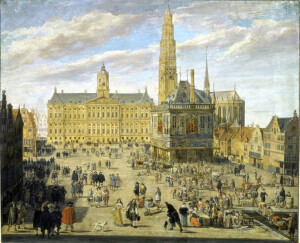
Amsterdam, 17th century
Replacing original labels
Luthiers such as Gerrit Menslage, Jan Vos, Hendrik Ravekens, David Kleynman, or Jasper Libbega and Pieter Opperdoes—who were recently discovered in the archives—are all registered as violin makers, but there is still a lack of work that can be definitively attributed to them. This is due to the fact that many original paper labels bearing the maker’s signature or name are no longer present on the instruments. Some have been lost, but many original labels have been replaced with forgeries bearing the names of famous makers such as Amati, Rugeri, Stainer, and Albani. The Amsterdam school, in particular, has suffered greatly from this. The model, the style of construction, and the materials used indicate that the work must come from Amsterdam, but it is impossible to link the work to a specific name. This is one of the reasons why finding an original signature can be decisive; an anonymous body of work can suddenly be linked to a maker.
The Importance of Research
On rare occasions, a luthier may have lived only a short life and thus operated a workshop under his own name for just a few years, as was the case with Arent Roelofz van Munster. A violin made by him turned up in America but has since disappeared again. This is a typical example of why research into the Dutch school is sorely needed. With this in mind, the Hendrik Jacobs Foundation (www.hendrikjacobs.nl) was established, a foundation dedicated to restoring the reputation of early Dutch violin makers and their instruments and highlighting their national and international significance. The National Musical Instrument Fund endorses the importance of this research and wholeheartedly supports the initiative of the Hendrik Jacobs Foundation.
Sources
D.J. Balfoort, 1931 *De Hollandsche vioolmakers*, H.J. Paris, Amsterdam.
Bolink J, Giskes J, Lindeman F, Stam S, 1999, 400 Years of Violin Making in the Netherlands, Amsterdam.
Amsterdam City Archives, accessed in 2025
- Auteur
- Hubert de Launay
- Date
- 12 March 2025